Row, fisherman, row
Keep on rowing your boat
Brotherman, brotherman
Simon Peter, James and John
Come ashore to feed the hungry belly ones
— The Congos, “Fisherman” (1977)
I visited New Forest Primary and Infant School last Friday to drop off toys and craft supplies for children affected by Hurricane Melissa. The students were out on holiday, but the security guard, the school secretary, and I talked for a while about the community’s needs before Melissa, what the storm took, and what remains. It was a sobering yet productive talk. Realizing that New Forest is just ten minutes up the road from Alligator Pond, I couldn’t come so close and not stop at Little Ochie for a fish lunch.
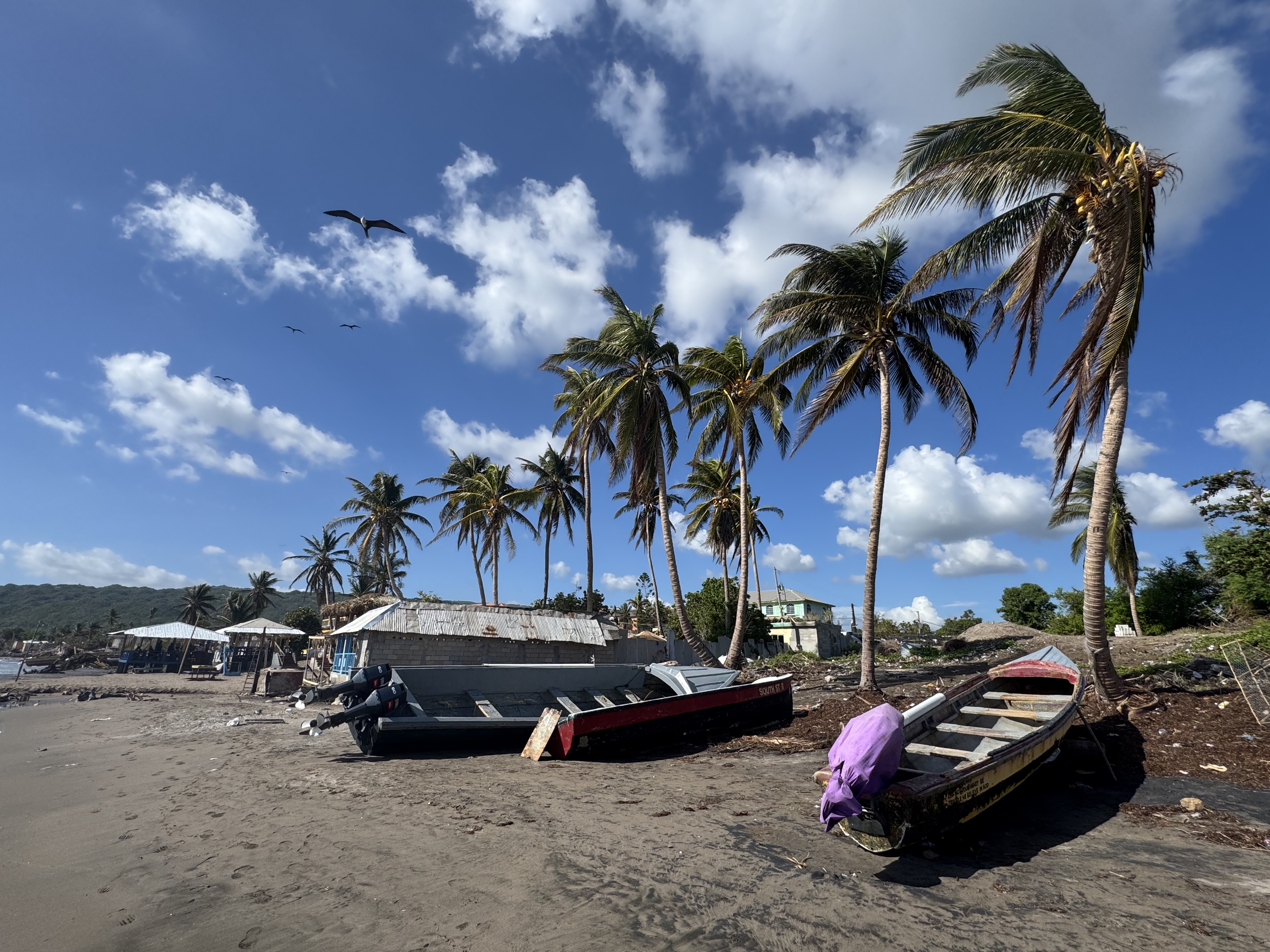
I wasn’t looking for a story, but I reached the beach before I was actually hungry and decided to stroll along the coast, observing the pelicans and seagulls noisily flocking towards discarded fish guts, the coconut trees bent at awkward angles despite the light wind, and the colorful boats that lined the shore, their operators already done for the day.
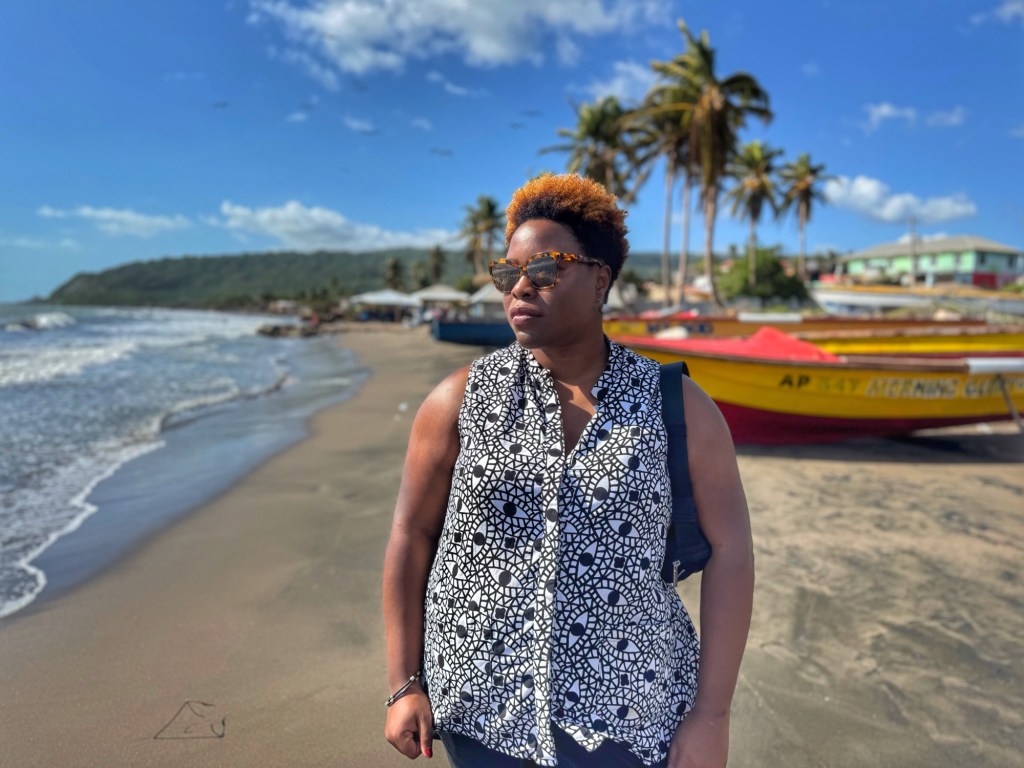
Alligator Pond is a fishing village on Jamaica’s southern coast straddling the parishes of Manchester and Saint Elizabeth. Unlike the tourist-oriented coasts in the north, this black-sanded shoreline is all about hard work. Though there are crocodiles in nearby rivers, the name comes not from any reptile- the community was christened by geology. The Don Figueroa Mountain range, viewed from the beach, resembles an alligator’s back, with the promontory of the headland jutting out like its head, and the water settling inside its mouth, like a pond.
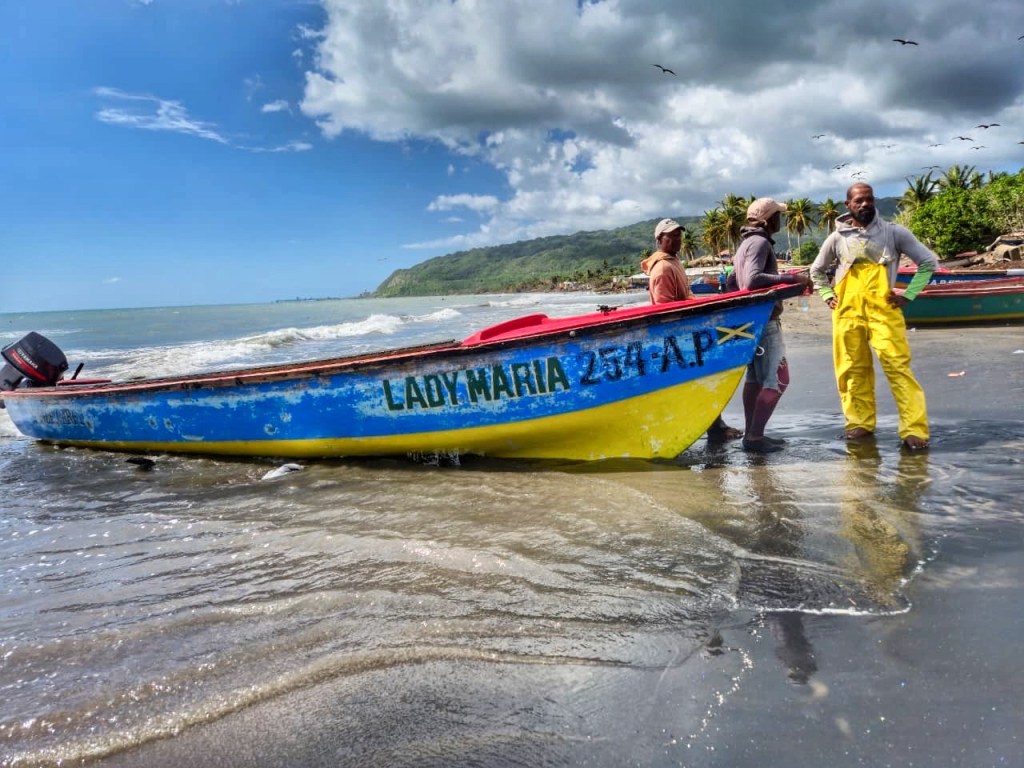
I was initially going to walk westward so I could claim having trekked across parishes, but I spotted a man wearing a grey hoodie, his chiseled arm holding a hull, his beautiful smile gleaming in the afternoon sun as he and two others advanced a boat labeled Lady Maria 254-A.P. towards the coast.
The man I spotted first, wearing a grey hoodie, stood inside the boat, bent, and lifted a curved plank. The other two worked alongside, one a third of the way down the hull, the other nearer the bow. He jumped out, pulling as they pushed, then set the plank into the shallow water, easing Lady Maria forward with a practiced motion learned long before this day. The bark-like plank forms a surface that lets the hull glide back onto the sand. The man in the grey hoodie leans backward as he pulls, watching the others. The brother in yellow overalls leans forward and runs alongside the boat until she is firmly set, then lets go, turns, and scans the land. At the back right, the brother in the peach hoodie steps in and delivers the final shove, settling her fully into the sand.
I continued towards that beauty, and as I walked, I noticed that the second man’s face bore a strong resemblance to the first. I introduced myself and learned that all three are brothers: Errol, Dwayne, and Adrian Dixon. But nobody down here calls them that.
Lady Maria is a fiberglass-and-wood vessel powered by a gas engine, and she belongs to all three of them: same mother, same father, same boat, and two sisters besides.
Their parents are still together, still alive. Their father, now about seventy-five, is operating, as Errol puts it, “in our shadows.” The boat and its engine were inherited from their father. They replaced the old engine recently, but the inheritance is the thing. In a world where so many fathers are absent or unknown, where so many sons must invent themselves from scratch, these three men fish together because a man who learned the sea from his brother, his own father having died young, taught them everything he knew.
I wanted to know about the boat’s name. Lady Maria was just a name their father liked. Sometimes a boat is just a boat. This boat carries three brothers to sea and back every day, and the echoes of whatever woman the elder Dixon was thinking of when he painted that name on the bow.
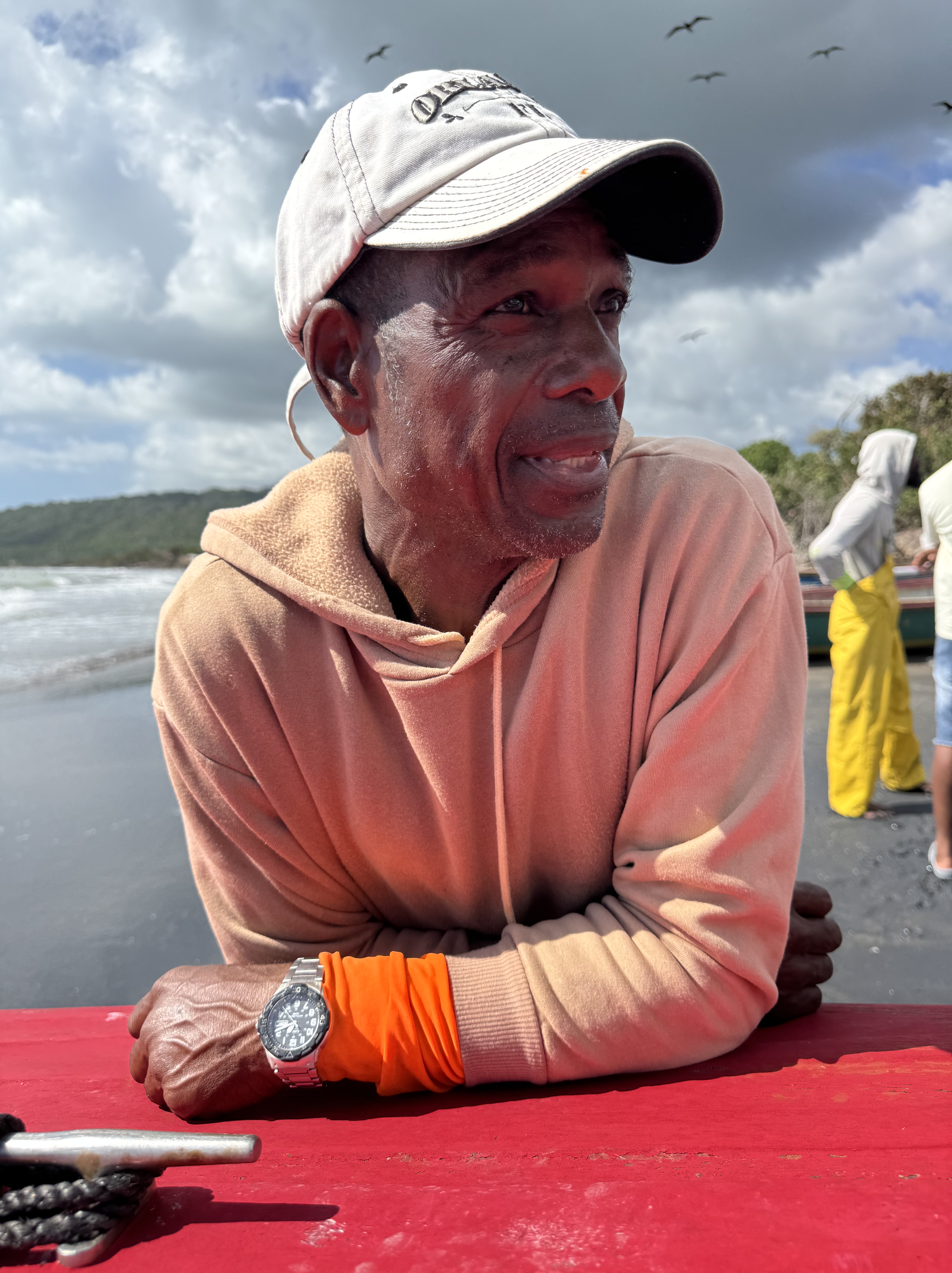
Errol “Channy” Dixon is fifty-four, the eldest, a widower with four children, scattered in the way that children tend to. His youngest is five, his eldest thirty-two. Some are overseas in the US and Canada, and one serves in Jamaica’s military. None of them took to fishing.
Channy went to Alligator Pond All-Age, as did his younger brother Dwayne. He left school at sixteen because he already knew what he wanted. He didn’t need a certificate to tell him the sea was his. He owned thirty fish pots before Melissa; ten of them have been replaced and are now set in the water. Each pot is built by hand from inch-and-a-half mesh wire, stick, rope, nail, and cord- the way their father taught them. You set them, you wait, you hope. The sea gives, or it doesn’t.
Channy wears a peach hoodie and a contemplative air. He is the brother who holds things in his chest, who thinks before he speaks. Who gave the final thrust to moor Lady Maria on the sand. When he does speak, it is worth hearing. He is serious about his time, and entertained my fascination for exactly an hour before tapping on his wristwatch and calling on his brothers to push out once more.
When I ask what his father taught him, Channy doesn’t hesitate: “Be honest on the sea. Don’t trouble no one’s fish pot or stuff like that. You know? We must be careful and look out of we eye when the weather is hard. He teach us some positive things. To be honest.”
Honesty on the sea. It sounds simple until you understand what it means- that a man’s pots are his livelihood, that the temptation to raid another’s catch is real, that integrity is a daily practice when no one is watching. The phrase “look out of we eye when the weather is hard” speaks to the flight dispatcher in me. I use complex tools and forecasts every day, and they are often wrong, but Channy’s ancestral knowledge and his familiarity with the sea are what saves his life and his brothers’ day after day. Not instruments, not forecasts- just his own eyes reading the sky and the water. This ancient knowledge- the kind you can’t study in books, the wisdom that sharpens a man’s senses to these patterns- is etched in Channy’s smile.
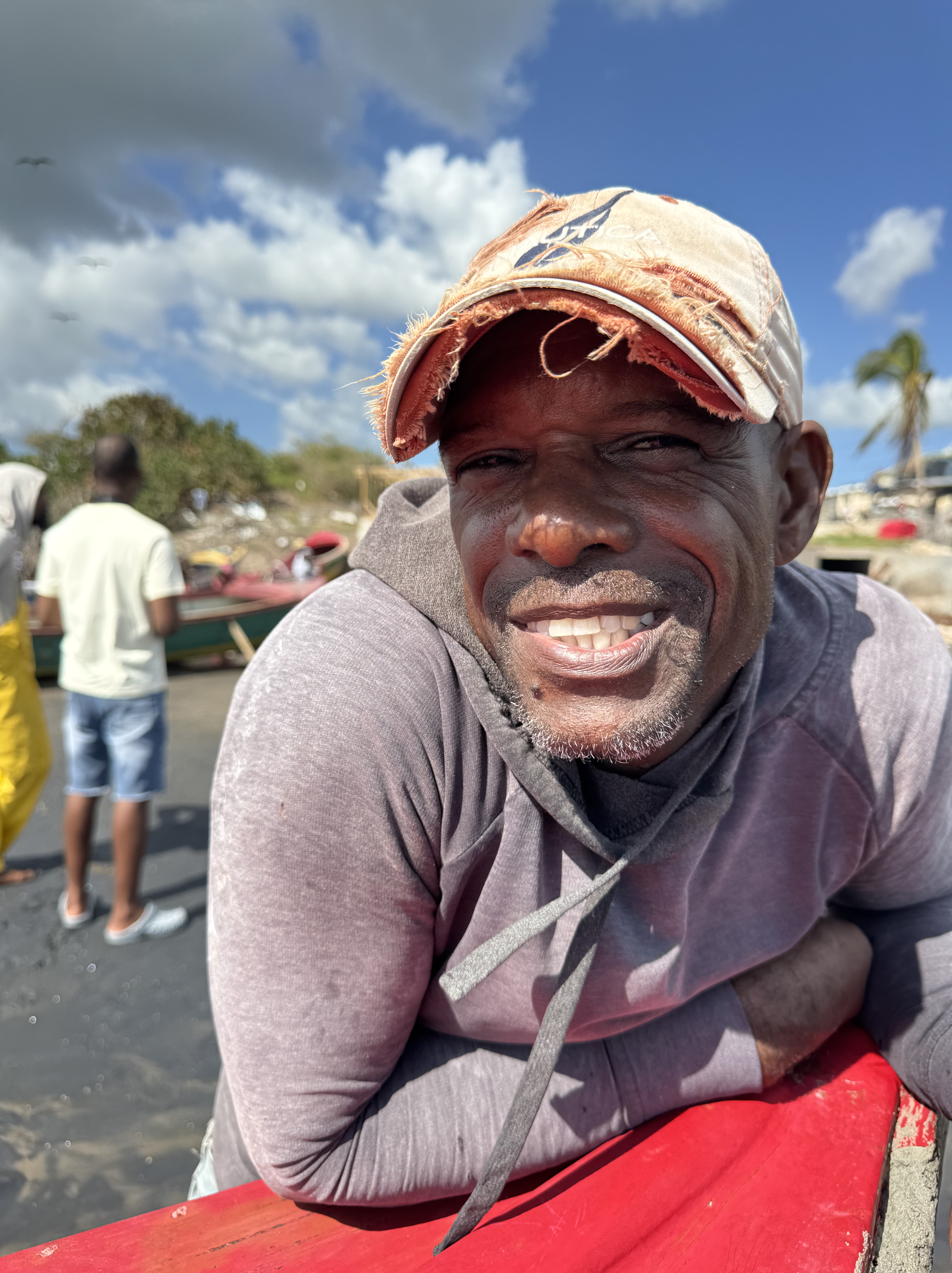
Dwayne “Kerry” Dixon turns fifty-one in January. He is the middle brother and was the first to catch my eye. He has three children of his own, aged twenty-eight, twenty-three, and twenty-two. His face is weathered in a way that speaks of salt and sun, though his impeccable skin belies his age, and when he smiles, it is the smile of a man who has made peace with the sea’s indifference.
Kerry is the one who went away. He left school at seventeen and worked in the hotels as an assistant chef. His best and favorite dish is curry chicken, and he’s particular about it. “Curry should have a rich color’” he insists. He eats with his eyes first, so no pale stew will pass muster.
What kept him from the boat during those early years? “I was worried,” he tells me. “If all of us out there and something happen, the whole family of us gone. So, I avoided fishing.”
“I branched off early,” Kerry says. “I chose not to live nearby.” But the life of a fishing village pulled him back, the way it pulls all the Dixon men, making him the second-born Dixon boy but the third to take to the sea. Twenty-two fish pots to his name before Melissa, fourteen of them now working the depths. He is also a landscaper, because, he says, fishing alone will not sustain a man.
I asked if he knew whether his grandfather was a fisherman. He doesn’t. Their father didn’t talk much about his own dad- the man died when their father was very young. What Kerry knows is what was passed down: his dad’s migration from St. Elizabeth to Alligator Pond, a brother who took the fatherless boy out on the water and taught him the sea. Then he taught his sons. The knowledge passes like an inheritance more valuable than any engine, though the engine matters too.
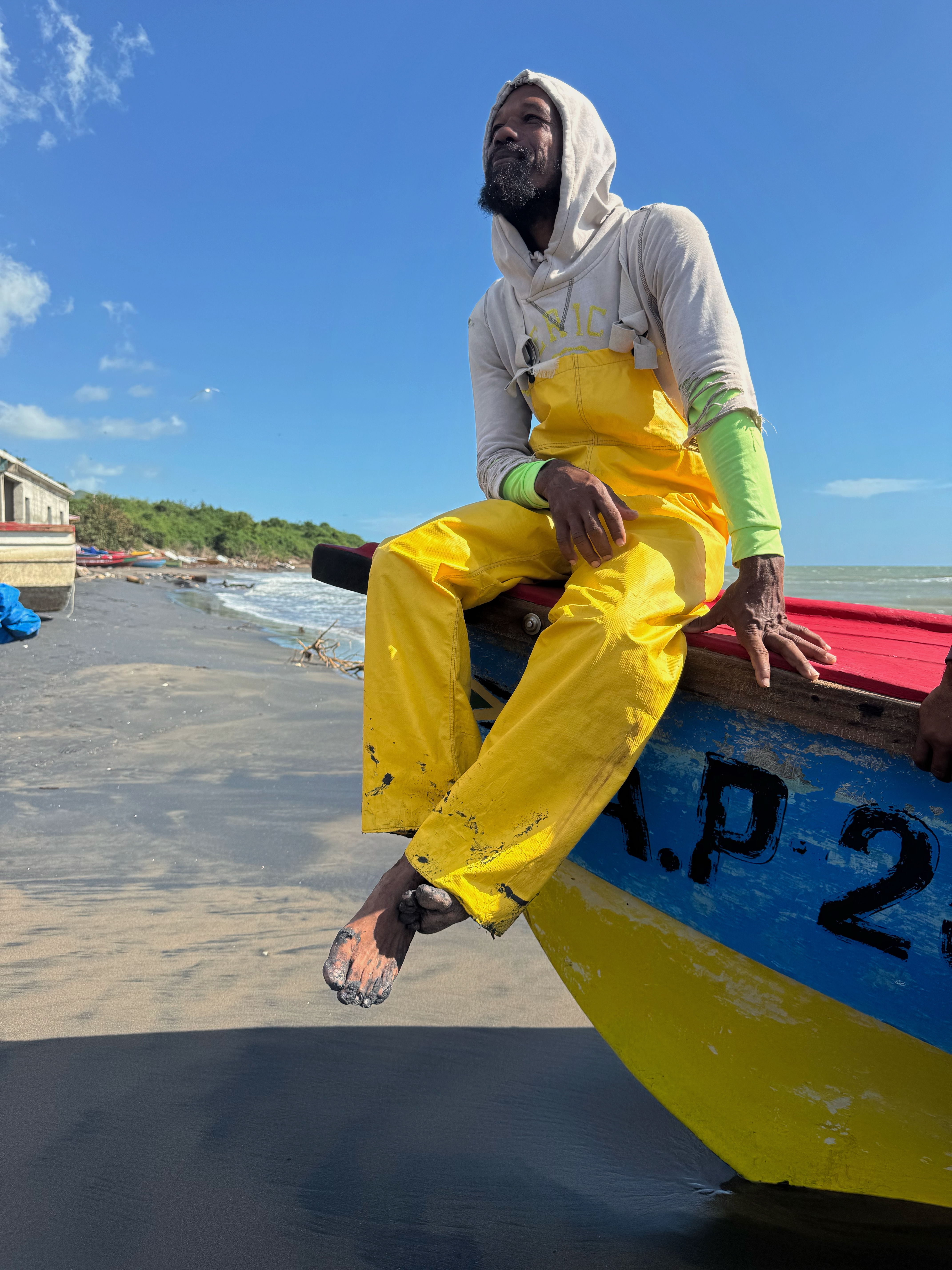
Adrian “Chin” Dixon is the youngest. When I ask his age, he grins and says, “Young and lean.”
He lives with a partner and has three children almost spanning two generations: twenty-two, ten, and three. His eldest son already fishes, working on a boat in partnership with his mother, who sells the catch. Chin had thirty pots before Melissa, though only seven are set right now.
Chin went to school at New Forest, not Alligator Pond All-Age like his older brothers. But it was Channy who brought him out onto the water and taught him as their father had taught Channy. The eldest taught the youngest. The knowledge was passed down not through ceremony but by doing.
He wears yellow waders and likes to perch on the bow of Lady Maria, watching the sky. Chin is the quiet one. He lets Channy and Kerry tell the stories, offering a word here or there but mostly holding his peace. Perhaps he is saving his words for the sea, where bush don’t have ears, and a man can think out loud.
There is a practice I want to give a breath to, because it is quietly radical: the brothers set aside a portion of their catch as a sort of tithe to their parents. In Jamaica, honoring your parents is expected- adult children send money home, check in, provide when they can. But the Dixons do something different. They didn’t leave; they stayed on the same shore their father taught them to work. They don’t send money back from somewhere else, they set aside a pot within the shared enterprise. Their father, now about seventy-five, no longer goes out on the water. But he is provided for. He “operates in the shadows,” meaning he is present in ways that don’t require visibility. They set out a pot just for dad, and the proceeds from that portion go to him and their mother. It’s not charity; it’s structure. Their gratitude is built into the economics of the boat. A pot for dad. He’s still crew, even from the shadows.
In the context of Jamaica, in the context of fishing communities anywhere, it’s its own kind of miracle that both their father and mother are alive and aging as a couple. When so many families are fragments scattered across different yards, different fathers, different stories- the Dixons are whole. One boat, three brothers, working the same shore they were born to. They do not take it for granted.
In Jamaica, we say “bush have ears.” Walls too. The only place to speak freely is somewhere no one can hear you. For the Dixon brothers, that place is the sea.
They carry a shut pan- a lunch box that snaps closed, out on the boat with their food for the journey. But the phrase works as a metaphor too: the shut pan is what you open only when you’re far from shore, when the engine is cut, and the waves are rocking gently. What’s inside stays inside until you’re ready. That’s when brothers can talk. Every secret, once talked on land, isn’t secret anymore.
“Teeth and tongue have to meet sometimes,” Kerry says. “But we talk it out. Nothing nuh bottle up.” They describe their partnership as conflict-free, not because they never disagree, but because they have a place to disagree and a commitment to resolution. “Say what you need to say before it spoils.” The sea is their conference room, their therapist’s office, their church. Three brothers. Same boat. No festering.
But the sea isn’t what it was.
Hurricane Beryl came in 2024. The recovery wasn’t too long- fish pots found, beach restored, the sea settling back into its rhythms after a while. Then came Melissa.
Kerry calls it a mammoth of a storm. The sea floor is still unsettled. Parrot fish, which spend ninety percent of their day grazing on the reef and filtering sand, grinding up hard coral and expelling it as fine-grain sand, need a stable bottom to do their work. The bottom is not stable. Everything down there is still rearranging itself. Catches are meager. The brothers are patient because patience is the only option, but patience doesn’t pay for gas. Each Dixon brother owns his pots individually, but they share the boat and split the costs. Two twenty-five-gallon bottles of gas per trip, registration fees, and licensing. Time is the other currency, and they spend most of it together.
Before the storm, they secured the boat and engine, battened down their windows and doors. They didn’t shelter together- each man tended to his own household, but they visited to help each other prepare. And afterward, in the dark with no light and no cell service, they walked the distance to check on one another. They’ve slowly repaired their damaged homes. The storm took fish pots. They’re still rebuilding- buying wire, sticks, cord, lacing, rope.
Kerry remembers the morning after: “The storm blow Wednesday, and we went back out the Thursday. It was calm, calm. Calmer than today when you see it. Imagine a hurricane just passed through and the weather just come right back down to zero.” Barely any waves, just sunlight rippling on the face of the water and the wake of the boats.
Even the pelicans are fewer now, displaced by the storms. There are not as many as there used to be, circling the boats, waiting for scraps. This is another absence you feel before you can name it. These Melissa-bent coconut trees are among the last ones standing after she broke everything else. The brothers told me to photograph them. “Remember these coconut trees,” Kerry said. “They’re the last ones left.” They stand claiming the shoreline like stubborn survivors.
Up and down the beach, boats wear their names: Rimsky AP 526, Morning Glory AP 547, My God AP 634, I Fighter. One boat under construction has Psalm 68:1 painted on its hull: Let God arise, let His enemies be scattered.

Fish is selling at $1,300 Jamaican dollars per pound now. Kerry thinks the price may drop after the holidays. Jamaica’s marine fisheries employ over 40,000 people and support more than 200,000 livelihoods. Only about ten percent of the country’s registered fishers have insurance. The rest carry the risk alone, and three of those fishermen haul their boat onto the sand at Alligator Pond every afternoon.
The Dixon brothers are registered and licensed, as required. They can be stopped at sea, inspected, and held accountable. They follow the rules, though the system asks much of them. But when storms destroy their pots, when hurricanes scatter their livelihood across the sea floor, what comes back to them?
The Jamaica Fishermen Cooperative Union, founded in 1942 and 4,000 members strong, has no local chapter in Alligator Pond. Why not? “Crabs in a barrel,” Channy says. Meetings are held. Few people follow through. Some fishermen hear the word union and think trouble, think fees, think someone trying to tell them how to work the sea. They want the freedom of the water without the structure that might protect them all. Then again, wanting to organize means risking being misunderstood on a beach where everyone already knows your name. The collective action problem is alive and well on this beach, as it is everywhere humans try to organize.
After the storms, it became harder to pretend that standing alone was strength. The brothers advocate for a life insurance pool, for health coverage, for some measure of security against the sea’s indifference and the economy’s cruelty. They also speak against destructive fishing. At least the use of dynamite has stopped. Explosions that indiscriminately kill fish and other marine organisms are particularly harmful to coral reefs. That’s progress. But the trawling continues. Bottom trawling in sensitive habitats, dragging heavy nets across fragile seabeds, destroys corals and seagrass. There’s a fish sanctuary about nine miles out from Alligator Pond, but the trawlers interfere with it by drawing too close and killing young fish before they can mature.
The Dixons use pots. They wait. They’ve been doing this long enough to know that you can’t just extract from the sea and give nothing back. The sea remembers.
“Every day a fishing day,” Channy says, “but not every day a catching day.”
There’s a moment towards the end of the Congos song where the harmony lifts and Cedric Myton’s rich falsetto calls out across the rhythm like a man hailing someone from a distance:
We’ve got to reach on higher grounds
Rain is falling
We’ve got to reach on higher grounds
I thought about what higher ground means for a fisherman. It’s not leaving the sea. It’s having someone to pull alongside you. It’s your brother coming home. It’s setting new pots in troubled water because that’s what your hands know how to do. The Congos sang it in 1977, Lee “Scratch” Perry producing at the Black Ark: Simon Peter, James and John, come ashore to feed the hungry belly ones. The biblical fishermen who became fishers of men. Who left their nets to gather people.
The Dixon brothers want to do both. They want to keep fishing. It is their life, their inheritance, the thing they know and love. But they also want to become fishers of men in another sense: to start a union, to gather the fishermen of Alligator Pond, to organize against the crabs-in-a-barrel mentality that keeps them all scrambling separately. They’ve seen what the storm takes when you stand alone.
I stood in awe as I watched them push Lady Maria up the sand, three brothers working in unison, their bodies knowing exactly how to move together. Channy, Kerry, Chin. Same mother, same father, same boat, same sea. Carrying the shut pan out past the breakers, where bush don’t have ears. Hauling their catch home every afternoon to feed the hungry belly ones. And now, trying to unify their fellow seafarers.
The sea bottom will settle. The pelicans will return. The pots will fill again. And the Dixon brothers will continue towards higher ground.

Row, fisherman, row.
Brotherman, brotherman.

 Negril Stories
Leave a comment