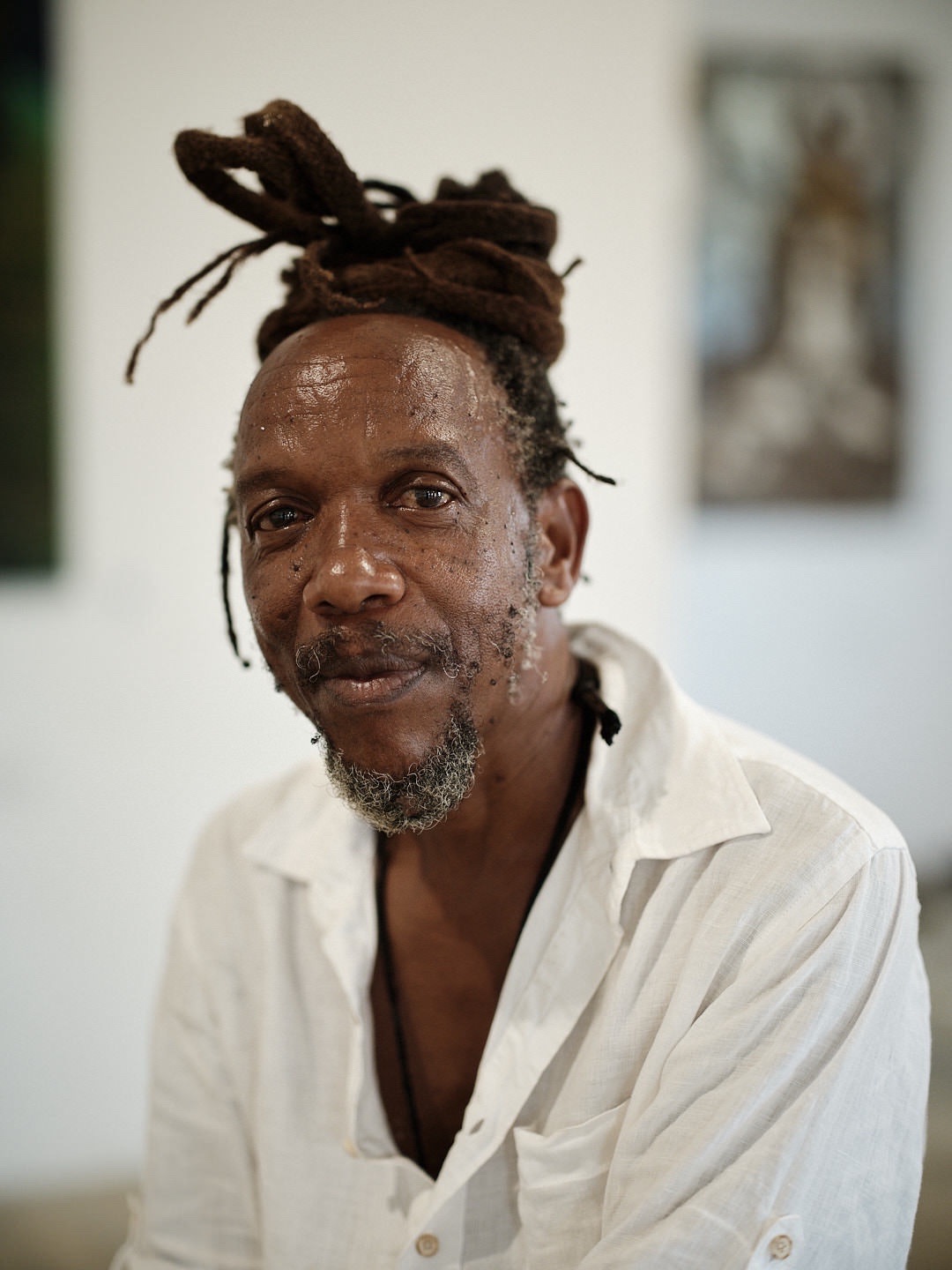
Wadada, Our Lovely Brother

Yesterday morning, Treasure Beach lost one of its most devoted sons. Mazola Wa Mwashighadi was murdered in Billy’s Bay during a home invasion. The violence that took Mazola from us is made even more unbearable because of the healing work he was preparing to offer in this very moment of community trauma.
Born in Kenya’s Taita-Taveta District on April 9, 1964, the same year Jomo Kenyatta became Kenya’s first president, Mazola carried the spirit of the burning spear, that generation that understood freedom as something to be built daily through commitment to community. His name, loosely translated, means son of an outsider. That meaning would echo throughout his life’s work.
He came to Jamaica in 1997 on a Commonwealth Fellowship to study at Edna Manley College. He came for a year. He stayed for twenty-eight.
That was a choice. Jamaica was an active choice. He could have returned to Kenya after his fellowship ended in 1998. He chose to stay. He chose this coastline, this community, these people. Even as he remained connected to Kenya, participating in political conversations there, never forgetting the land of his birth, he built his life here. He built it with his hands. The son of an outsider chose to stop being outside, decided to root himself so deeply in Treasure Beach that his studio became part of the landscape itself.
When I saw him at Calabash in May, he was seated at a table with my nephew and his architecture professor, deep in conversation. After all my years of distance, Mazola remembered me. That recognition meant everything, the kind of memory that comes from truly seeing people, from being present in community. I spoke briefly with him about the work ahead, about what the community would need after Hurricane Melissa. I was supposed to meet him at his studio next week to discuss his healing work with survivors in more depth.
That meeting will never happen now, and I’m still trying to hold that.
Mazola built his studio, Found Objects, at the far end of Frenchman’s Bay, constructing much of it himself. It was more than a workspace. He shaped it into its own kind of artwork, piecing it together from materials the community had cast aside, letting it settle into the landscape rather than standing apart from it. Inside, Mazola transformed what others dismissed as junk into powerful assemblages that told stories nobody else was telling. He worked alchemically, drawing on fragments from the shores and streets of Treasure Beach to reimagine them as meditations on identity, freedom, environmental crisis, and resistance. The son of an outsider became the artist who found meaning in what the world left outside, discarded.
His art refused to bend. In pieces like I’m Not Combing My Hair, he claimed the freedom to be. “You see, people will call it rebellion, but it’s really freedom,” he said. “If God made me this way, why should I change?” That was Mazola. No performance, no apology. His work reminded us that the Earth is our collective mother, that we must shed our flagged identities to care for her and each other honestly.
Mazola understood something essential about diaspora and belonging. Kenya and Jamaica both threw off colonial rule in the early 1960s, and Mazola recognized how that shared history shaped both places. He saw the same struggles playing out across the Black diaspora: the work of reclaiming culture, of rebuilding what colonialism tried to erase. He held both places in his heart, following Kenyan politics, engaging in conversations about his homeland’s direction, and maintaining those ties. But he chose Jamaica as the place to do his life’s work. He described himself simply as a vessel: “Art is a vehicle where I do many things, propagate my own philosophy, but also I am just a vessel.”
And in this season of profound trauma, Mazola was living that philosophy. Just days ago, he wrote: “We were still healing and recovering from Hurricane Beryl, which devastated our Community and others last year. As if that’s not too much to bear, on the 28th of October, this year Melissa, a category 5 Hurricane visits. The One-eyed-Monster has left a trail of devastation never seen before in this Jamaica, land, and people we love.”
He witnessed the distribution of food, survival supplies, and building materials for reconstruction. He noted that his country of birth, Kenya, wouldn’t be sending volunteers. But he was here, ready to do his part: “I am here, I got to play my part in the physical and spiritual healing process.”
His Community Art Healing Therapy Workshops were scheduled to begin this Sunday, December 8th, and continue through the 15th. Free workshops where people could “celebrate and express our resilience, with colour, clay, mixed media, collage, found objects” under his guidance. This wasn’t art as decoration. This was art as survival, as processing, as reclamation of voice after trauma. Mazola understood that creative expression after disaster is not a luxury but a necessity, that people need space to transform what cannot be spoken into something that can be held, examined, and eventually released.
The DNA Mazola carried came from a bloodline of community guardians and rainmakers. He lived that inheritance in Treasure Beach, building spaces where art could flourish, where people could gather, where the discarded could be transformed into the sacred. His work will continue to speak in every piece that remains, in every person whose life he touched, in the model he created for what it means to embed yourself in a place and serve it truly.
Mazola was born in Kenya. He made Jamaica his home. He was our brother, not because of where he was born, but because of his commitment to this land and these people. Because he understood that kinship is built through care, through showing up, through the daily work of building, healing, and creating together.
Yesterday was December 5th. Twelve years ago, on that date, Nelson Mandela passed away. Another giant of liberation, another man who understood that freedom requires forgiveness alongside fight, that nation-building is soul work. The symmetry of these dates reminds us that we lose our guardians, but their work remains.
I honor Mazola Wa Mwashighadi: artist, teacher, guardian, vessel, brother. And I commit to continuing the work of healing and creation that Mazola understood to be essential, especially in moments like these.
I write this on my 37th birthday. In a few hours, I’ll be doing a painting exercise with fifth graders, helping young hands make something from nothing. I didn’t plan it this way, but here I am, holding grief and gratitude in the same breath, asking myself what it means to build something that matters, to root yourself in a place and give what you have. Mazola answered that question with his whole life. The least I can do is keep asking it with mine.
Those workshops were supposed to start on Sunday. Let them still happen. Let someone carry forward what he began. Let the community still gather to express resilience through color, clay, and found objects, as he intended. That would be the most authentic tribute.

Rest in power, wadada. The earth remembers you.


Leave a Reply to DonCancel reply