“Every song carry a story.”
— Joe Minott, Moore Town
On August 1, 1834, the British Empire abolished slavery in its colonies. But the formerly enslaved were bound into a so-called apprenticeship for four more years, and were not fully free until 1838. That is what we commemorate every Emancipation Day. There are Jamaicans, though, who had been free long before that Augus’ Mawnin’, and they are called the Maroons. The country’s only woman among its National Heroes is Nanny of the Maroons, who led her people against British occupation in a decades-long war that they ultimately won.
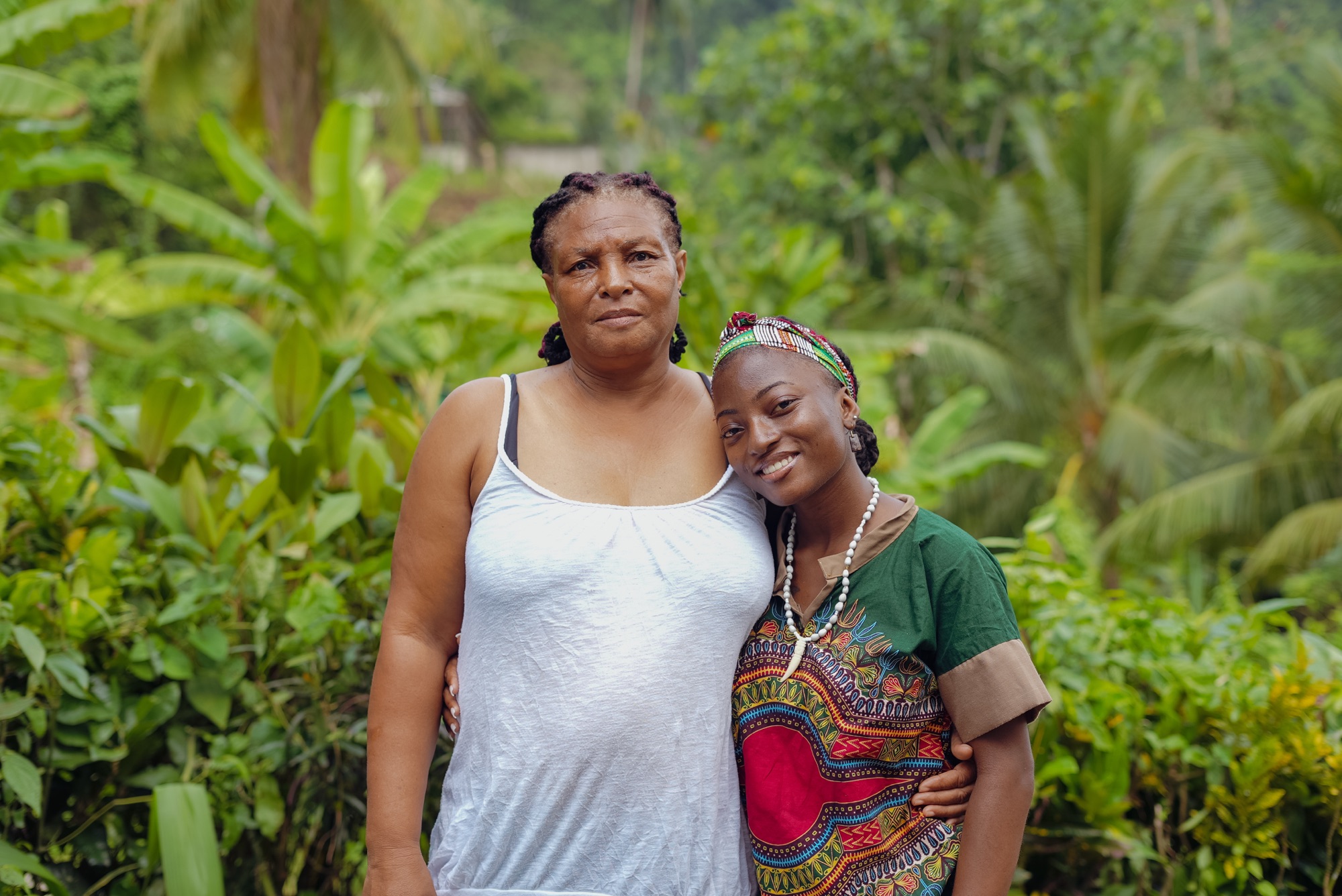
I spent a Sunday morning with a daughter of that legacy in Portland’s Rio Grande Valley. Her name is Lomorra, but I was introduced to her on Instagram as Hope Vocals, and she is increasingly being recognized as a cultural ambassador; that title tells only part of her story.
I arrived at half past seven, and Moore Town was already awake and announcing itself. The crowing of roosters came at me from every direction, never quite subsiding, not even in the heat of the day. Below the road the river ran green and low, and my lungs were refreshed by the cleanest air I have breathed in months.

Lomorra Dillon is twenty-three years old. She was waiting in dashiki print, green and red, accessorized by a white beaded necklace and anklet, her abeng and white rum in hand. Her cousin Jaden was nearby holding the Kromanti drum. She is soft-spoken, so quiet that twice during the visit I asked her to project, then finally gave up trying to hide the mic and clipped it directly onto her collar. This is the voice that, laid over the Hill & Gully riddim as Kumina Medley (Walk in Deh), has charted in unexpected places, like Portugal and Japan, and made her, in the space of a few months, the most audible young Maroon.
Six months and two weeks
Her mother started to tell me this story on the verandah of the family home, while I peered inside at a wall of framed certificates.
Hope was born on the eleventh of May, 2003 — Mother’s Day — at six months and two weeks. She spent her first six weeks in intensive care at St. Ann’s Bay Hospital. “The only thing that wrong with her when she born was her lungs never developed,” Annette Aarons told me, matter-of-fact, the way I have heard women speak of a fear once it has been survived. The last of five children, the only girl. Her godmother named her Hope, because that is what the family had in abundance while they waited to see whether she would make it.
She lived. Years later, she added “Vocals” to the name herself.

“I know she was born for this reason,” Miss Annette said. “It’s not surprising.”
Her grandfather, Major Charles Aarons, who taught her to play Kromanti drums before she was five, who “helped us to curate our gifts,” as Hope puts it, was honored by the Smithsonian at its Festival of American Folklife decades before Hope was born. The certificates on the wall tell a part of his story, and his descendants live the rest. Her mother sings the Maroon traditional songs and lectures on the culture; in 2016 she toured American schools and museums with Georgia State University. Her great-grand-aunt was one of Moore Town’s storied midwives; Miss Annette said that no mother she cared for ever died in childbirth. She lived to 106.

Hope was the youngest member of the Grandy Nanny Cultural Group when she joined, and became the lead singer by age nine. She remembers her early stage fright at a celebration in Scott’s Hall, another Maroon settlement, where the women encouraged her not to worry about the crowd, to start singing and show them what she could do. “I took the mic, and I started singing,” she said. “And then all the fear went away.”
“I am always around elders,” she said. “I have an old soul.” There was a cousin everyone called Old Man. “Ironic,” she said, “he’s an old man, but we called him Old Man.” He was Moore Town’s number one herbalist, and he taught her the bush medicine and some of the Kromanti language. There was Joe Minott, who taught her the songs and their weight: “Every song carry a story. If somebody drop a stone there, they’ll sing about it, and you remember it hundreds of years after.” Old Man and Joe are now gone.
Near the old cemetery, I asked who she hears speaking through the song she has brought to the world. She did not hesitate.
“My grandfather was one of my protectors. He passed away. My father was one of my protectors. He also passed away in 2024. My brothers… my brothers are now my main protectors. I feel like they speak through that song.”


Walk in Deh
The medley begins in a language most of the world cannot understand and was never meant to.
Maroon history is passed down orally for reasons. “They didn’t just fight the British and won off luck,” she told me. “There’s definitely some things that we can’t share. Certain information is too powerful for certain people… not everyone have the right intention.”
It opens with an invocation, and it names her people — yengkungku means Maroon — and what follows is a calling-in: she is introducing herself, announcing that she is here, and asking everyone, the living and the ancestors, to join her in the dance.
Mi madda seh no walk a night.
Then the central song arrives, and it is older than she is. Older than I am. I first heard Walk in Deh as a girl. It was popular at nine-nights, and I sang it the way children sing, for the catchy melody, for the game of it, and did not fully understand the lyrics until I heard a Kukudoo tape a few years ago, and nodded at the realization. The song has been handed down because the reason for it never went away. Innocence is among the things that are often taken before its time, and a warning cloaked in music is much easier to deliver.
My mother says don’t walk at night. A bird will pick your cherry. On the track, every line of the warning is answered by a shout, “Walk in deh!” Hope heard the song in St. Thomas as a small child, seven or eight; she picked it up from the parish that is Kumina’s home. Nobody explained it to her either. “You’ll figure it out on the way,” she said. “When you grow up, and you hear the words, you understand.”

I asked her what it is about. She answered plainly, without flinching: “Young women, mainly, should be careful, especially at night. There are many dangers out there for women. Many predators. We have to just be cautious.”
Do young women still need this song? “Yes, they do. Definitely. We’re always in need of protection or warning.”
What struck me, listening to the medley afterward, was its order. First the invocation: gather in. The ancestors, the living, her own yengkungku named in the first line. Then the warning, the mother’s voice, the oldest euphemism there is, planted in children early enough to bloom when it is needed. But the medley doesn’t leave the girl standing alone in the dark it has just described. Hol’ him tenor. Play dem cool. Grab somebody and dance. The drummers are instructed, inside the song itself, to ease the tempo; malembe, she taught me, means slowly, and the drums transition from caution into unbridled joy.
The girl calls out to her community; she is held inside a sacred circle; she shares the warning she received; the circle answers back, and then the circle dances with her. This is the Kumina ring, a gathering of a people who have always held grief and celebration in the same breath.
The ancestral languages on the track are Kromanti and Bongo, “and I am both.” Two drums live inside the family home: the board drum is the Kromanti one that Jaden carries, and the skin drum is the Kumina one you sit astride. Hope plays both.
Up the Rio Grande
To reach Moore Town you drive up the Rio Grande Valley until Digicel signal disappears, and then you keep going. Portland weather runs on its own schedule. “One minute it’s sunny, then the other minute it’s raining,” Hope shrugged. The valley holds other Maroon communities besides this one, each with its own significance. Cornwall Barracks, which shares a post office with Moore Town, has many historical sites.
Moore Town could pass for an idyll: rivers and streams and springs everywhere, water so crisp that locals and passers-through alike stop to drink. But the idyll is peppered with unfinished and abandoned houses, lush tropical growth taking over the sarcophagi of someone’s once-dream home. There is a tree more than a hundred years old, planted to hold the memory of a brother lost in that very spot. Poincianas flame all over the blue mountainside.
We walked her road, and she greeted everyone we passed by name. Every single person. Angel and Trina, picking hog plum at Nanny’s Bump Grave. Kerron by the post office that serves two communities. Mikey at the river, who is a true-born Maroon and has a farm up by Nanny Falls, who told me there’s no murder here, that everybody live good, and that when he was a boy the river ran deep enough to dive. Moore Town is small enough to know entirely, and Hope knows it entirely. The knowing runs in the family: Miss Annette was thoroughly familiar with the photographer Ackeem’s lineage, and asked him about relatives who had moved abroad.


“It’s very peaceful,” she said. “We can leave our door open if we want to and sleep, and that gives you a sense of peace that you can’t find in many places in the world.” I had asked her how Moore Town has protected her. The bylaws are housed in her family home, she noted; outsiders who want to settle go through a process. “And we own our lands.” The community that warns its daughters is also the community that guards its gate.
At Budu Wash Wash, Hope spotted a turkey vulture circling. “A long time me no see one John Crow so low, you know,” she said. I was not brave enough to ask whether that was an omen, or what it might have meant.
Her own sanctuary is Nanny Falls, the waterfall by which she sits in the Kumina Medley video. “I’m big on nature, so I’m mostly in nature spaces.” When Ackeem posed her on a stone in the river, barefoot, abeng in her hands, green water carrying her reflection, she did not have to reach for an expression. She was simply at home.

The peace is under pressure, and she does not pretend otherwise. “People keep leaving because there isn’t enough employment here,” she said. “It’s a beautiful community… and the culture is on the verge of dying, actually.” She said it evenly, in the same voice she uses for everything, and then immediately turned it: “But thankfully for this new breakthrough, people are getting more intrigued, and we can start on our journey to preservation.”
Her hopes for the valley are specific, and they are attainable. Workshop spaces to pass the culture to the Maroons coming up, and to impart what is shareable to the rest of the world. Moore Town needs electronics for the primary school. Employment, so the young people have a reason to stay, so the community that is now scattered abroad can return to encircle girls like her. A foundation, someday, to formalize the work of caring for the elders and disabled residents. Hurricane Melissa laid these needs in stark relief when the valley faced its share of the damage with, in her words, “not much help and not much representation.”
Bush tea
The medicine grows in a ring around the house. “My father used to boil medicine for years,” Miss Annette recalled. “Most of the bush them that you see round the yard, that is what we use to boil medicine.” Hope walked me to a plant and picked it: John Charles, her favorite for tea. Good for several things, she said. “Mainly diabetes,” and according to her, “it nuh taste too bad.”
I checked with my herbalist cousin afterward; she knows John Charles as a bush for chest cold. But the plant, Condea verticillata, has in recent years been the subject of laboratory studies finding exactly what Hope’s ancients already knew: it has shown blood-glucose-lowering effects comparable to standard diabetes medication. The elder they called Old Man taught a small girl the herbs, and the science has spent the years since catching up to him.


Miss Annette invited me to have a look inside their tinder box. It is a smaller horn than the abeng, stuffed with tinder wood, “the first matches.” Had we not come to visit, Hope would have been in the process of preparing the traditional Jamaican Sunday dinner: rice and peas, with the salt thing being the only variable. On special Sundays, and on ceremonial observances, she joins the family in preparing cacoon, one of the largest beans in the world, poisonous unless you know the process: burn it, soak it for days, soften it. “Only the Maroons know how to prepare it so that it’s edible.” They wear it as jewelry, too; Hope showed me a beaded necklace with a huge central cacoon pendant. A people who can render even the poisonous thing nourishing are uniquely powerful. This knowledge of transforming the toxic into tasteful is exactly what this family has been honored for bearing, and sharing.
Nothing before its time
Hope said she was afraid of branching out, of leaving the safety of the group, where the elder women had carried her through stage fright, to now inhabit the form of a solo act. “When you’re alone, you control the crowd’s energy. You are in control of everything.” She had social anxiety from early high school. She doubted herself, drifted from her purpose. “I knew that this was what I was born to do, but I was afraid to tackle it head-on. But now, I am confident, and I am ready.”
She describes the inspiration for her now-viral video as though it were an ambush of her spirit. She was cooking breakfast when she first heard Di Genius’ Hill & Gully riddim. “I felt it in my spirit to do the song. I was so excited, I couldn’t control myself. I couldn’t focus on anything until I got the video done. It wasn’t planned. I just went outside, and those were the first words that came to my mind. And I knew that was my ancestors’ help.” Di Genius saw the video and called. Fae Ellington, Auntie Fae, reached out after the first drum-and-abeng post to say the girl had touched her spirit. Her third and fourth singles, Warrior and God’s Timing, have just been released: Warrior, she wrote, because “our ancestors fought for us in the past, but we fight for ourselves every day”; and “nothing happens before God’s Timing.”

During our conversation, Hope returned again and again to one phrase: nothing before its time. It was never offered as a slogan. She said it the way people repeat truths they have lived long enough to trust. At twenty-three, she carries an inheritance far older than herself. Her wisdom reaches back through the first Maroons, men and women who still remembered the homelands they were stolen from, and who carried that memory into the mountains of eastern Jamaica, preserving it in language, music, ceremony, and story until it reached her.
She arrived two and a half months ahead of schedule, and spent her first six weeks at St. Ann’s Bay while her lungs recovered from the work they had begun too soon. She survived so that twenty-three years later, she could become one of the voices carrying that inheritance.
Preserving by simply living
Her spirituality, which some online commenters flatten into something mystical, is real, defined, and palpable. People say God and the ancestors don’t work together. She disagrees: “Even if you check the Bible, we talk about our ancestors all the time. God of Meshach, Shadrach and Abednego. God of Moses, God of Abraham. Those are ancestors. They passed away already. So God and the ancestors work together.”
Hope rejects the idea that she is doing something exceptional. Fans praise her constantly for preserving Jamaican culture, and she receives it the way one might receive commendation for eating breakfast, or brushing teeth. “It comes naturally, and it’s a necessity to me. It doesn’t feel like an extraordinary thing to me personally, because it’s one of my norms… I’m not saying that it isn’t great to preserve our culture, but it should be normalized.” The institution the Smithsonian and documentarians came to study, she simply calls home.
She also rejects the idea that her people erected a wall between themselves and the rest of Jamaica. “Since the song, people are now knowing that Maroons aren’t exclusive. Jamaicans are Maroons. Maroons are Jamaicans… Nanny didn’t fight for one set of people. She fought for 83 years — 83 years of warfare — and won. And she wasn’t fighting for just Portland. She wasn’t fighting for just Accompong. It was for Jamaicans on a whole. She fought with different nations of people. There was a lot of information that was left out.”
Even so, there is sealed knowledge: recipes, chants, and memories that must stay in Moore Town.
Everything else she is trying to share as widely as she can. The circle drawn in the song’s first line, yengkungku, her own people, will open to protect the whole island. On Emancipation Day, of all days, I find myself meditating on what a twenty-three-year-old Maroon told me: the freedom her ancestors took was always meant for all of us.

I thought I knew the story I would be telling when I went to Moore Town earlier this month. I expected a matrilineal arc running from Nanny to Miss Annette to Hope. What I found instead was broader than just a line of women. Her inheritance is an entire community, and Hope is okay with sharing it with all of Jamaica, with Africans at home and abroad.
After years of hearing fatherhood discussed almost exclusively through the language of absence, I was struck by how visible fathers, brothers, uncles, and grandfathers were in Hope’s story. They were not peripheral figures. They were named. They were remembered. And they were there. The women instruct. They warn because they remember. Again and again, the men appear as protectors and shields. It felt less like a rigid division of roles than a shared obligation.
Music, and her culture
Late morning, back at the house, her little cousin Jaden came up from the river soaked and delighted, and got the instruction every Jamaican child knows: don’t stay in the wet clothes.
I asked Hope what it would mean to wake up tomorrow with none of the international attention, with nobody knowing Hope Vocals, just Lomorra Dillon again. What would still hold her together?
Music, she said. And her culture. “Whether people are watching or they’re not watching.”
Music is the thing that steadies her. Before she wrote songs to share with the world, she used them to see herself, to clear her mind.
“Of course, I am making songs for others, but I also make them for myself. To keep myself motivated.”
And before she was rising on the reggae charts, she was already what she still is: a culture bearer, carrying forward her family’s tradition. It is not a role she considers exceptional or even particularly noteworthy. She has always been one to keep her people’s voice alive.
I didn’t drive away with a literal translation of the Kromanti and Bongo lyrics of the medley, but Moore Town’s architecture of protection stuck with me. So did the roosters’ announcement that the night is survived, that the light has come, that the girl they hoped would live is still singing.

When something terrible happens, we go looking for a reason. We need a villain, and failing a villain, we often settle for a rule. No walk a night. Like so many warnings passed from mothers to daughters, the song places its attention on the one most at risk. But the cherry does not get picked because a girl walked at night. The cherry gets picked because the bird felt entitled to it. And some cherries get picked in broad daylight.
The mothers knew this. They sang the warning to the girl because the girl was who they could reach. No song was ever going to instruct the bird. What the song could do was make sure she was never alone with the warning.
That is what I hear now in Hope’s medley. The warning is never left to stand by itself. First the ancestors are called in. Then the mother speaks. Then the circle answers back. The tempo softens. Someone is pulled into the dance. The girl is not abandoned to fear; she is gathered into her people.

Maybe that is why this warning has survived, of all places, in a town where families sleep with the door or a window open. Moore Town does not only sing the caution; it has built the answer to it. A road where everyone has a name. Brothers who become protectors. Elders whose voices still travel through the living. A circle that answers back. A door that never fully closes.
So much of modern life mistakes independence for health. We know fewer of our neighbors than our parents did. Fewer children grow up circled by grandparents; too few young people can recall elders who became family though unrelated by blood. We are more connected than any people in history, and more alone. And the measures we have of a good life — longevity, health, walking through grief, feeling a sense of happiness — all favor the ones who are rooted in community. Moore Town is that kind of community, because everyone is known by name.
The song and the open door are the same instruction, delivered two ways: stay where love can see you.
May every Jamaican family be able to sleep with a door or a window open, as they do in Moore Town.
May every girl walk beneath the stars without fear.
May the voice that calls out the warning be able to take rest.
Photographs by Ackeem Sterling

Leave a Reply